If you are searching for how to remove negative reviews, whether a review removal service is worth it, or how to spot reputation management scams, this guide covers:
- How review removal actually works on Google and Yelp, and what is impossible
- The claims reputation management scams make, and the questions that expose them
- Step-by-step instructions to challenge a policy-violating review yourself
- Realistic timelines, based on our experience
- When you should not flag a review at all
- Special care for medical practices
- What fair pricing looks like
We run a local SEO and reputation management agency, and challenging policy-violating reviews is a service we sell. We explain the full process here so you can do it yourself. If you would rather hand it off, see the pricing section at the end.
How review removal actually works on Google and Yelp
A review leaves Google or Yelp in only four ways: the reviewer removes it, the platform removes it for breaking policy, a legal process results in its removal, or automated spam detection catches it. No third party has a back door into any of them.
Google. Google’s own help page says you can report any review, but only reviews that violate its content policies are eligible for removal (Google Business Profile Help). Being negative, unfair or inaccurate in your view does not qualify by itself. The categories Google lists include spam and fake content, off-topic content, conflict of interest, and the sharing of private personal information.
Yelp. Yelp separates reviews into recommended and “not currently recommended” using automated software. Yelp has said repeatedly that no amount of money can change this, and that its salespeople do not tell businesses otherwise (PCWorld, reporting on the FTC's closed inquiry). In its 2023 Trust & Safety Report, Yelp said about 78% of reviews were recommended, 16% were not recommended, 4% were removed by its moderators, and 2% were removed by the reviewers themselves (Business Wire).
What this means for you. The only legitimate removal strategy is accurate reporting: pick the review that really violates policy, cite the specific rule, attach evidence, and be patient. Everything else is either a reply strategy, a legal route, or a promise nobody can keep.
| Platform | Who decides | What a business can do |
|---|---|---|
| Google’s moderators and automated systems | Report the review, appeal a rejection, reply publicly, use the legal removal route for defamation | |
| Yelp | Yelp’s moderators, plus automated recommendation software | Report the review and reply publicly. Nobody can adjust the recommendation filter |
Reputation management scams: the claims to watch for
The most common reputation management scam is a promise to do something only the platform can do. These pitches work because they target two feelings at once: fear of a damaging review, and hope that one monthly fee will make it disappear. Claims like the ones below circulate across the industry, and several of them appeared in a pitch sent to one of our clients. We do not name companies in this guide, because the patterns matter more than the brands.
| The claim | Why it does not hold up | What is real |
|---|---|---|
| “Our proprietary AI detects and deletes negative reviews” | Google and Yelp control removal. No outside tool has delete access. | Software can help monitor reviews and organize reports. A policy match still has to be made and submitted. |
| “We move your positive reviews out of ‘not recommended’” | Yelp’s recommendation software is automated, and Yelp says no payment can change its decisions. | Genuine reviews from real customers can accumulate over time. Yelp discourages asking for them. |
| “Fully automated reputation management, no manual work” | Each report needs the right policy cited and evidence attached. That is judgment, not automation. | Faster monitoring and drafting, with a person deciding what to report. |
| “Screenshots of reviews we successfully removed” | A screenshot shows a review existed. It does not show that it was removed, by whom, or why. A reviewer may simply have edited or deleted it. | A live link or before-and-after record that shows the removal and the date. |
| “Guaranteed removal” or “pay only when reviews are removed” | Nobody controls the outcome. See the pricing section for how this shapes behavior. | Honest ranges, and a fee for work done. |
| “Offer expires this week” | Pressure to sign before you can check anything. | A provider who is happy for you to compare options. |
Mass reporting from many accounts. We have also heard from people in the industry about a tactic where several accounts report the same review. This is manipulation of the reporting system, and extra reports do not make a review more likely to be removed: a review either violates policy or it does not. It can also put the client’s profile at risk if the activity draws attention. Ask any provider whether they use anything besides the platforms’ official reporting and appeal tools.
This is not new. In 2015, Yelp sued a company that offered to remove negative reviews and boost positive ones, calling such offers scams; the company denied wrongdoing and said its services were legal (Mobile Marketing Magazine). More recently, reporting has described agencies selling “reputation management” that relies on aged social accounts to shift conversations (The Hustle). The common thread is a promise that cannot be verified.
Back to top ↑10 questions to ask any reputation management company
Ask these before you pay anyone. A trustworthy provider answers them plainly and in writing.
| Question | A good answer sounds like |
|---|---|
| 1. How exactly do you get reviews removed? | “We report policy-violating reviews through the platform’s official tools and appeal when needed. We cannot delete anything ourselves.” |
| 2. Who will actually do the work? Is it in-house or subcontracted? | A named team or a clear statement that work is subcontracted, and to whom. |
| 3. Can you show me exactly what you submitted and when? | Reports, dates, and the policy cited for each review, shared with you. |
| 4. What is your removal rate, and how do you define it? | A range with a definition, and a plain admission that some reports fail. |
| 5. What happens if nothing gets removed? | “You still receive the report and our recommendations. Removal is never promised.” |
| 6. Do you use anything other than the platforms’ official reporting and appeal tools? | A flat “no.” Hesitation here is a warning sign. |
| 7. Will you tell me when not to report a review? | Yes: some reviews are better answered or resolved than reported. |
| 8. Is there a contract, and what does cancelling look like? | Terms in writing, and a simple exit. |
| 9. What will I see in the first 30 days to show work is happening? | A named list of deliverables, such as an audit of your reviews, reports filed with dates, and a first monthly report. “These things take time” with nothing to show is a warning sign. |
| 10. Does the price change if I complain? | “No. The fee is for the work, and it stays the same.” Be cautious if a big discount appears only after you complain, since it suggests the original price was not tied to the work. |
A provider that resells another company’s work is not automatically a problem. Agencies often bundle outside services into a larger retainer. What matters is whether you know who is doing the work and what they are claiming on your behalf. Be especially cautious if the vendor’s claims, such as “AI deletion,” are being passed along as the agency’s own promises.
Back to top ↑How to report and challenge a negative Google review, step by step
You can report any Google review, but only those that violate Google’s policies are eligible for removal (Google Business Profile Help). Follow these steps for each review you think qualifies.
-
Check it against Google’s content policies. Typical grounds include spam or fake content, a reviewer with no real experience of your business, conflict of interest (for example a competitor or former employee), off-topic content, harassment or hate speech, illegal content, and sharing private personal information. A harsh but genuine opinion does not qualify.
-
Gather evidence before you report. Save screenshots of the review and the reviewer’s profile, and note why it breaks a specific rule. If you can show the reviewer was never a customer, keep records that prove it without exposing anyone else’s private information.
-
Report the review. Open your Business Profile on Google Maps or Search, go to Reviews, tap the three-dot menu on the review (or click the round report icon), choose Report review, and select the reason that best fits. You can also use Google’s Reviews Management Tool to submit and track reports.

Google Business Profile: Round report icon located at the top right of each review. -
Wait, and track the status. The Reviews Management Tool shows the status of each report. If Google removes the review, it emails you. Google gives an expected response time, but in our experience decisions often take far longer, sometimes three to four weeks.
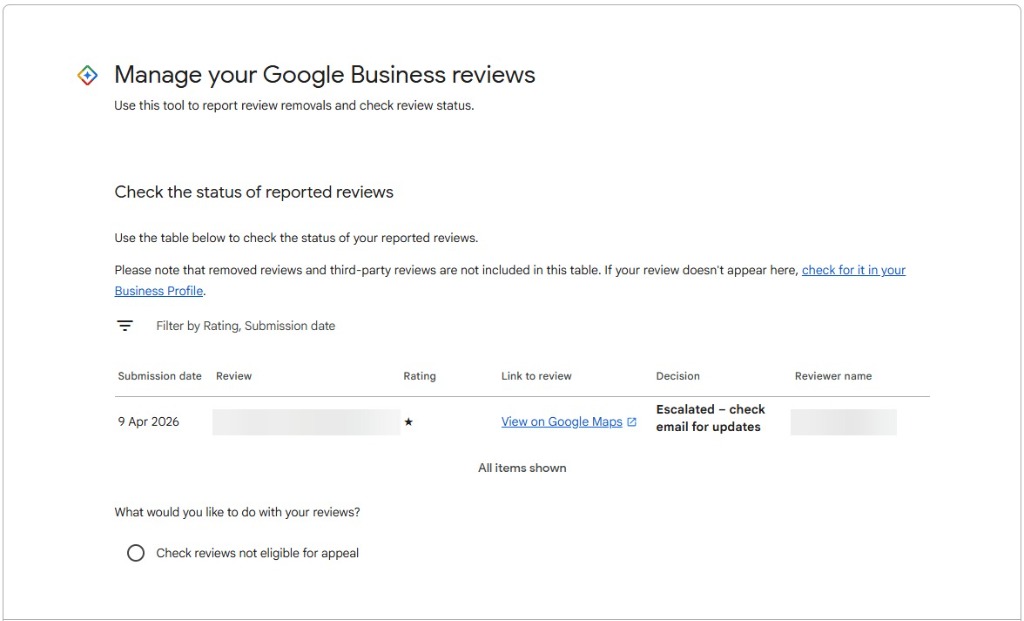
Google Reviews Management Tool: Status dashboard showing reported review marked “Escalated – check email for updates”. -
If the review stays, appeal. Google gives you the option to appeal. Use it to submit anything in writing that challenges the reviewer’s claims, such as correspondence, invoices, or records that contradict the account. Be factual and keep it short, and attach the sources for any factual point you make, such as a government health agency page or a published guideline.
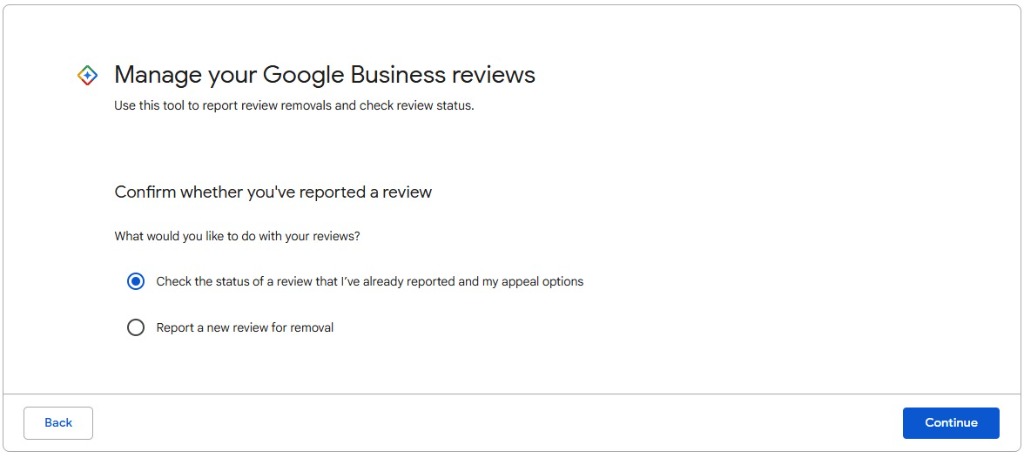
Appeal Flow: Navigating appeal options within the Google Reviews Management Tool. -
Reply publicly while you wait. A calm, professional reply helps future customers whatever the outcome. Do not argue, and do not reveal details about the reviewer.
-
Escalate sensible cases only. For reviews that include defamatory claims, see the legal routes section. Do not submit the same report repeatedly or ask others to report it for you from multiple accounts.
How long does it really take? We have not formally logged our timelines, so treat the following as experience, not measurement: Google’s expected response time is rarely met in our cases, and some decisions take three to four weeks. Plan for weeks, not days. Timelines change, and this is accurate as of October 2026.
What if the review is not removed? Sometimes a review that looks like a clear violation is kept. When that happens, your best options are a well-evidenced appeal, a public reply, and, where the content is defamatory, the legal route.
Back to top ↑How to report a negative Yelp review, and what “not recommended” really means
Yelp does not let businesses delete reviews. You can report reviews that violate Yelp’s Content Guidelines, and Yelp’s moderators decide. Yelp’s decisions are usually faster than Google’s, but they are also less forgiving of vague reports.
-
Match the review to a specific guideline. The reasons Yelp lets you choose from include false information, a review posted by someone affiliated with the business, a review posted by a competitor or ex-employee, threats, lewdness or hate speech, a review that does not describe a personal consumer experience, a violation of Yelp’s privacy standards, promotional material, a review of the wrong business, and extraordinary circumstances such as media-fueled reviews.
-
Log in to Yelp for Business and find the review. Use the three-dot menu on the review and choose Report review.
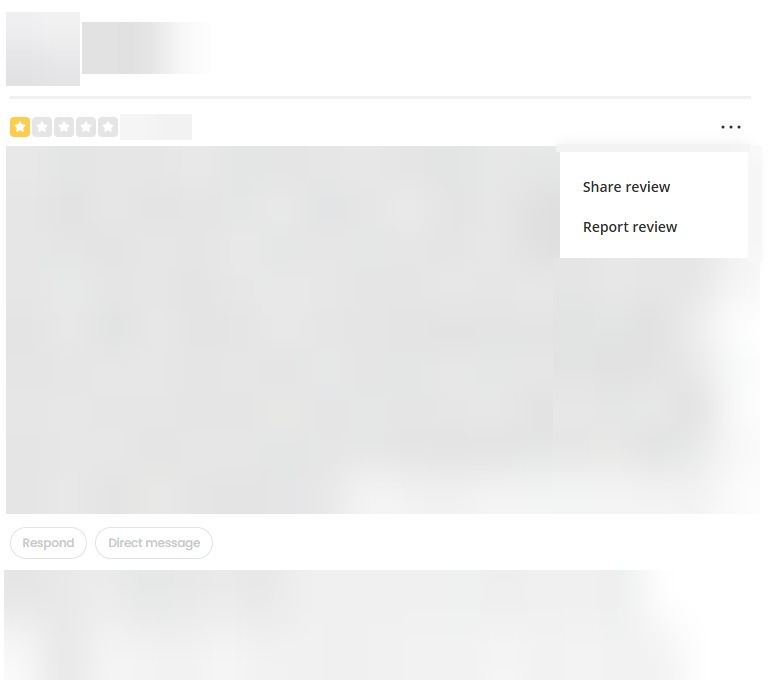
Yelp for Business: The review three-dot menu displaying the “Report review” option. -
Explain the violation factually. Name the guideline, quote the relevant line, and attach evidence. “This is unfair” is not a reason Yelp can act on.
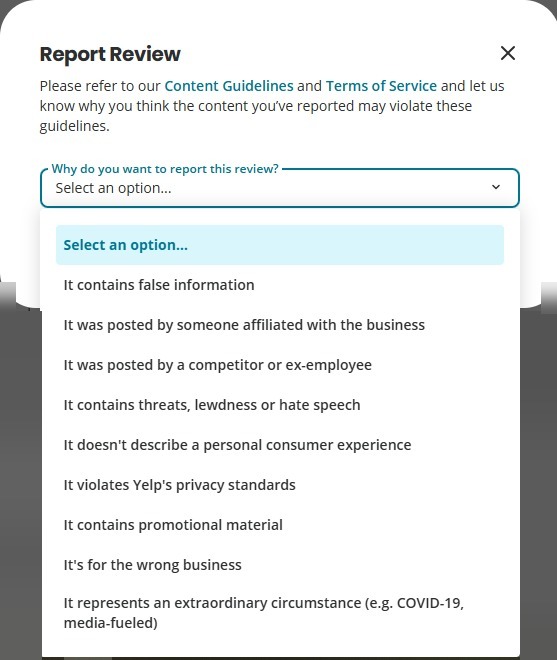
Yelp Reporting: Selecting the precise guideline violation reason in Yelp’s form. -
Watch your inbox. In our experience Yelp usually decides within a couple of days. If it removes the review, it emails you. If it does not remove it, you are typically not told, so no email generally means the review stayed.
-
If it stays, resubmit with a stronger case. You can make your case again with better evidence. In our recent experience appeals have been harder to win than they used to be, so confirm the current route in Yelp’s help center before you rely on it.
-
Reply publicly. A short, courteous reply with an offer to talk offline is often the best outcome available.
Enforcement is not always consistent. In a few cases, reviewers published a business owner’s phone number, full name and email address, and Yelp did not remove the review, even though we believed it breached its privacy rules. We mention it because anyone selling guaranteed removal is ignoring this reality.
What the “not recommended” section is
Yelp’s recommendation software automatically decides which reviews appear on your main page and which sit under “not currently recommended.” Yelp has said it does not take payment to change these outcomes, and it warns businesses that asking customers for reviews can trigger filtering (ABC7 Chicago). Yelp’s reviews are filtered, not deleted, so you cannot reposition them, and neither can a vendor.
The honest strategy is to serve customers well, let reviews accumulate naturally, and reply to the reviews that do appear.
Back to top ↑When not to flag a negative review: respond and resolve instead
Not every negative review should be reported. If a complaint is genuine, the better move is to fix the problem and answer it publicly. We do not report every negative review for our clients, and we encourage them to deal with the legitimate ones directly.
Here is the approach that has worked for us.
-
Decide whether it is legitimate. Does it describe a real experience, even an exaggerated one? If yes, treat it as feedback, not an attack.
-
Reply publicly, briefly and politely. Acknowledge the issue, apologize where appropriate, and invite the reviewer to contact you privately. Future customers read your reply as much as the review.
-
Reach out to resolve the complaint. If the platform and the situation allow it, contact the customer, listen, and put it right. Reviewers can edit or delete their own reviews, and in our experience a resolved complaint is the most reliable way a review comes down. We have seen many reviews updated or removed after owners spoke with the reviewer.
-
Let the reviewer decide. The remedy is the apology or the fix. Whether the reviewer changes the review is entirely their choice.
Guardrails you must follow
- Never offer anything in exchange for removal. No refunds, discounts or gifts conditioned on the review coming down. Google prohibits incentivized reviews, and the FTC’s rule bars paying for or incentivizing reviews that express a particular sentiment, positive or negative (FTC final rule summary). A reviewer can also screenshot your offer and post it publicly.
- Keep outreach polite and limited. Repeated or pressuring contact can backfire, especially on Yelp. One respectful message is enough.
- Do not threaten. The FTC’s rule also prohibits using groundless legal threats, intimidation or certain false accusations to suppress negative consumer reviews (FTC).
The fee we charge is for judgment: deciding which reviews to challenge, which to answer, and which to resolve. A provider paid per removal has no reason to give you that advice.
Back to top ↑Reputation management for medical practices and HIPAA-safe replies
If you run a medical practice, the biggest mistake in responding to a negative review is confirming that the reviewer was your patient. Federal regulators have said a covered entity may not confirm or deny that a person was a patient, or reveal other identifiable health information, in a public reply (Arnall Golden Gregory summary of an OCR enforcement action). In 2019, a dental practice settled with the U.S. Department of Health and Human Services for $10,000 after its Yelp replies disclosed patient information (Baker Donelson). The same source notes that responding is not prohibited, but it must avoid discussing care or other protected information. The ADA gives similar guidance: you can acknowledge reviews, but you cannot reply in a way that confirms the reviewer is a patient, even if they use their real name (American Dental Association).
This section is general information, not legal advice. Have your privacy officer or attorney approve your reply templates.
What a safe public reply looks like
- Thank the reviewer for the feedback without confirming they are a patient.
- State your general commitment to patient care and privacy, and say you cannot discuss any individual’s situation in a public forum.
- Give a phone number or email for your patient relations team.
- Never mention treatments, dates, staff involved, billing, or outcomes, even if the reviewer has already shared them.
“Thank you for your feedback. We take every concern seriously. Because of privacy laws, we cannot discuss individual situations online, but we would welcome the chance to hear more. Please contact our patient relations team at [phone or email].”
Outreach needs the same care. Contacting a reviewer can itself imply that they were a patient. Keep any outreach generic, avoid referring to care details, and clear your wording with your compliance contact first.
Reviews that present opinion as medical fact. Lay reviewers sometimes assert diagnoses, outcomes or misconduct with no evidence. You cannot refute them by pulling the patient’s record. These are the reviews where a careful policy report, a public reply that sets out your standards without discussing the case, and, for clearly defamatory claims, the legal route make the most sense.
We learn the business before we challenge a review. Before we report anything, we make sure we understand how the business works: its services, standard procedures and policies. When we are unsure, we ask the client to clarify, keeping our questions to general services and procedures, never a patient’s records. We also check factual claims in the review against authoritative sources, such as government health agencies, licensing boards and published guidelines. On Google, a factual error alone is generally not a policy violation. Yelp does list false information as a reporting reason, but you still need evidence, so this research often shapes the reply as much as the report. When a review does break a platform rule, it lets us make a specific, evidence-backed case.
If an outside agency handles replies for you, make sure the agreement covers privacy requirements, and that anyone writing on your behalf has been trained on what not to say.
Back to top ↑Legal routes for defamatory reviews, and the FTC’s fake-review rule
When a review makes false factual accusations that harm your business, policy reporting is not your only option. These routes are slower and may need an attorney, so use them for serious cases.
- Google’s legal removal request. Google’s help center includes a tool for reporting legal issues with Business Profile content (Google Business Profile Help). Use it when a review contains content you believe is unlawful, and include supporting documentation.
- Court orders. If a court has found content defamatory, a platform’s legal process is the route for acting on that order. Speak with an attorney who handles online defamation.
- Extortion. If someone threatens negative reviews unless you pay, Google’s help page points to a separate way to report extortion scams. Do not pay.
Be realistic. Defamation claims are generally made against the person who wrote the review, not the platform, and they require a false statement of fact, not a harsh opinion. An attorney can tell you whether your situation qualifies and whether the cost makes sense.
Do not make baseless threats. The FTC’s final rule on fake reviews, effective October 21, 2024, prohibits businesses from using unfounded or groundless legal threats, intimidation or certain false accusations to prevent or remove a negative consumer review (FTC; Global Policy Watch). The rule also bars buying or selling fake reviews and misrepresenting that the reviews you display are complete when negative ones have been suppressed. Civil penalties can apply; one summary put the maximum at $51,744 per violation (NutraIngredients).
This is a general overview, not legal advice.
Back to top ↑What review management should cost, and why we charge for judgment, not outcomes
Our standalone review management service is priced from $200 to $500 per month, depending on the number of profiles and how many reviews need attention, and it pays for time and expertise, not for a result. Nobody can guarantee a removal, so we do not sell one. We do not charge more than $500 per month for a single business; networks with many locations are quoted separately.
Why we do not charge per removal. If we earned money only when a review disappeared, we would be tempted to report reviews that deserve a reply instead. Because we are paid for judgment, we can tell you “do not report this one, reply to it,” and it costs us nothing to say so.
| Pricing model | What the provider is rewarded for | Risk to you |
|---|---|---|
| Pay per removal (“no removal, no fee”) | Getting reviews taken down, by any means | Pressure to report everything, including legitimate reviews, and to cut corners. Per-removal prices may be set high to cover the attempts that fail. |
| High flat fee with big promises | Signing you up | Months of payments for vague or unverifiable results |
| Fee for work done (our model) | Doing the work well and honestly | You pay in months when nothing is removed, so you need reporting to see the value |
What your fee covers
- Monitoring your Google and Yelp reviews
- Deciding which reviews are worth reporting, answering, or resolving
- Reporting policy-violating reviews and filing appeals with evidence
- Coaching on public replies and on respectful outreach to reviewers
- A monthly report of what we flagged, what each platform decided, and what we recommended
Before we send any final appeal, we also research the facts of the review and the business behind it, so each appeal is specific and accurate.
What we need from you. Your fee does not mean things happen on their own. We rely on your input before an appeal goes to the platform:
- Confirming the facts about your services, procedures and policies when a review touches on them
- Providing any records or correspondence that contradict the reviewer’s account, within your privacy obligations
- Answering promptly, since a slow reply delays the appeal
- Confirming the facts in the final appeal before we send it
Reviews that need your input wait for it, so timelines also depend on how quickly we hear back.
What no one can promise. We do not guarantee removals. We take our best shots, we are open about what fails, and you see the record.
For SEO retainer clients. Review management is included in our SEO retainer, within reasonable volume, because reviews directly affect local rankings and conversions. If you are already working with us on local SEO, this is part of the package.
Back to top ↑Our rules: what OrganicReachSEO will and will not do
We put these in writing so you can hold us to them.
WE WILL
- Report only reviews that we believe genuinely violate platform policy, and cite the specific rule
- Appeal with factual evidence when a report is rejected
- Tell you honestly when a review should be answered or resolved instead of reported
- Show you what we submitted, when, and what each platform decided
- Tell you plainly when a report fails
WE WILL NOT
- Promise or guarantee that any review will be removed
- Claim to use “AI” or any tool that deletes reviews or reorders them on Yelp
- Report the same review from multiple accounts, or use any method other than official tools
- Post, buy, or arrange fake reviews, or offer incentives for review changes
- Make baseless legal threats against reviewers
- Reveal patient information or confirm patient status in replies
How our approach differs from a typical reputation management pitch
We compete on process you can check, not on promises. Here is how our service compares with the pitches described earlier in this guide.
| A common pitch | How we work |
|---|---|
| AI that deletes reviews or reorders Yelp’s sections | We use only the platforms’ official reporting and appeal tools, and we say plainly that we cannot delete anything. |
| Every negative review gets reported | We decide review by review whether to report, reply or resolve, and we encourage resolving legitimate complaints directly. |
| Fully automated, no manual work | A person researches each review: we learn how your business works and check factual claims against authoritative sources. |
| Little involvement from you | We rely on your input before a final appeal goes to the platform. |
| Screenshots offered as proof | You see what we submitted, when, which policy we cited, and what the platform decided. |
| Guaranteed removal, or pay only per removal | A fee for the work, no guaranteed outcomes, and plain reporting when a report fails. |
None of this guarantees a removal. It means you can see, review by review, what was done and why.
Back to top ↑Frequently asked questions about review removal and reputation management
Can you pay someone to remove a Google review?
No. Only Google can remove a review, and only when it violates Google’s content policies. A company can prepare and submit a report for you, but it cannot delete the review or guarantee the outcome. Be cautious of anyone who promises guaranteed removal.
How long does it take Google to remove a review?
Google gives an expected response time, but in our experience decisions often take weeks, sometimes three to four weeks. We have not formally measured this, and timelines change, so plan for weeks and check your report status in the Reviews Management Tool.
Can a business owner delete a Yelp review?
No. Yelp does not let businesses delete reviews. You can report reviews that violate Yelp’s Content Guidelines and Yelp’s moderators decide. If Yelp removes the review, it emails you. If you hear nothing, the review generally stayed.
Can a reputation management company move reviews out of Yelp’s “not recommended” section?
No. Yelp’s recommendation software is automated, and Yelp has said no payment can change its decisions. Any company claiming it can move reviews between the sections is making a claim it cannot prove.
What kinds of reviews can be removed?
Reviews that violate the platform’s policy, such as spam or fake content, conflicts of interest, off-topic content, harassment, illegal content, or private personal information. A review being negative or unfair in your view is not enough on its own. Yelp does list false information as a reporting reason, but you will need evidence to support it.
Can I ask a reviewer to change or remove their review?
Yes, if you have first resolved their complaint and you ask respectfully. Never offer money, discounts or gifts in exchange for removal. Whether the reviewer changes the review is their decision.
Are reputation management companies a scam?
Not all of them, but many make promises they cannot keep. Watch for claims of AI that deletes reviews, guaranteed removals, screenshots offered as proof, pay-per-removal pricing, and pressure to sign quickly. Use the ten questions above to screen any provider.
How much does reputation management cost?
Prices vary widely. Our standalone review management service runs from $200 to $500 per month, depending on the number of profiles and how many reviews need attention, and it does not exceed $500 per month for a single business. It is included in our SEO retainers within reasonable volume. Whatever the price, make sure you are paying for documented work, not promised outcomes.
Can a medical practice reply to a negative review?
Yes, but a reply must not confirm that the reviewer was a patient or discuss any care details. Keep replies generic, give a contact route, and have your privacy officer approve your templates.
About this guide, and our disclosure
Disclosure: OrganicReachSEO sells review management and reputation services, so we benefit if you hire us. We wrote this guide so you can challenge reviews yourself, and so you can recognize reputation management claims that cannot be true. If you would rather hand it off, contact us.
Back to top ↑Sources
- Report inappropriate reviews on your Business Profile, Google ↗
- Report content on a Business Profile, Google ↗
- FTC ends inquiry into manipulated reviews on Yelp, PCWorld ↗
- Yelp 2023 Trust & Safety Report, Business Wire ↗
- Yelp sues RevLeap, Mobile Marketing Magazine ↗
- Reddit fake comments, The Hustle ↗
- Naperville restaurateur and Yelp, ABC7 Chicago ↗
- FTC final rule on fake reviews ↗
- FTC issues final rule on reviews and testimonials, Global Policy Watch ↗
- FTC announces final rule, NutraIngredients ↗
- Disclosing patient information in responses to online reviews, Arnall Golden Gregory ↗
- Physicians, think before you Yelp, Baker Donelson ↗
- Managing dental practice online reviews, American Dental Association ↗
Need help challenging policy-violating reviews or handling customer feedback? We review every case on its merits.
TALK TO US ↗